Humanoid roboticsin production.
Bending, welding and stamping. An assessment of processes and costs to design the first pilot and integration roadmap.
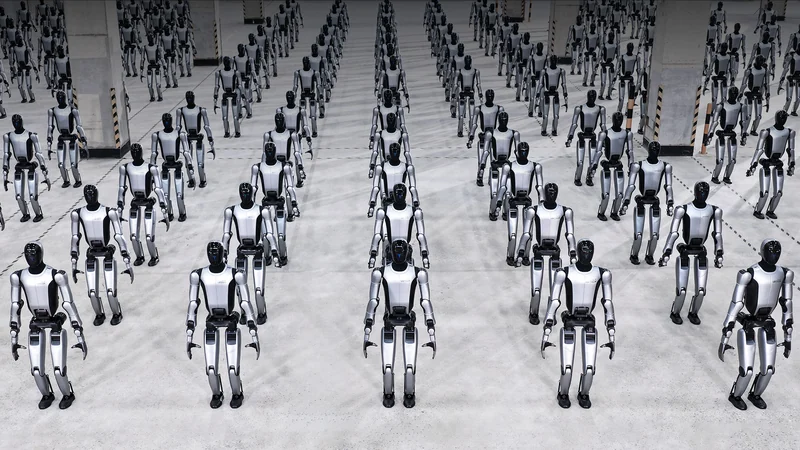
First, decidewhere to begin.
A manufacturing company wanted to understand how humanoid robotics could support production growth and the evolution of manual work. The question went beyond selecting a robot: it required identifying suitable processes, assessing the economics and defining a realistic sequence of experimentation, integration and skills development.
- Humanoid robotics
- Industrial assessment
- Roadmap and scenarios
Processes, technology and people.One development plan.
The assessment connects three production areas with an economic model and a technical roadmap. The proposed initial pilot has a clear scope; subsequent expansion depends on evidence from experimentation.
Three processes, different requirements.
Bending
The first process identified in the roadmap, with an operating sequence to delimit by product code and number of stages.
- Picking and positioning
- Bending sequences
- Quality checks and palletising
Welding
A subsequent area in which preparation, positioning and joint quality require dedicated checks.
- Component preparation
- Welding operations
- Inspection and finishing
Stamping
A further process to assess in relation to presses, feeding, part extraction and inspection.
- Preparation and feeding
- Interaction with the machine cycle
- Part extraction and verification
The assessment work
The project connects process engineering, AI models, machine integration and work organisation. Each stage of the plan provides the information needed to evaluate the next: understand the task, experiment, then decide whether and how to scale.
Identify priority processes
We analysed opportunities in bending, welding and stamping. The roadmap identifies bending as the starting point for a narrowly defined pilot: one product code, a limited set of operations and explicit evaluation criteria.
Build economic scenarios
The assessment compares investment and operating-cost assumptions, including acquisition, depreciation, maintenance, productive operating hours and human supervision. Different growth and utilisation scenarios help assess how potential benefits change.
Sequence development
The roadmap defines a staged approach: process data, training and simulation, human–robot integration, refinement and replication. The proposed initial proof of concept would test feasibility within a limited scope before extending the approach to other product codes and departments.
Processes, costs and operating constraints
Technical and economic assessment
Priorities, proposed pilot and roadmap
What the plan contains.
Explore the dimensions that turn an interest in technology into an industrial decision.
A scenario-based economic model
The analysis breaks down the cost of using robots and relates it to utilisation and production growth.
- Investment
- Robot acquisition and depreciation, distinguished from the costs of developing and integrating the solution.
- Operations
- Energy, maintenance, service and other recurring components considered in the scenarios.
- Productive work
- Assumed annual operating hours and shifts, to validate against process requirements and actual availability.
- Human support
- Staff needed for management, supervision and operational assistance.
Five technical stages, starting with a focused pilot
The plan proposes a repeatable method for each process. Development activities and tests are the steps that would follow the assessment.
- Set-up
- Mapping tasks, data, KPIs and variability, and preparing the test environment.
- Training
- Developing behaviours, training on collected data and testing in simulation.
- Integration
- Connecting existing systems, enabling human–robot collaboration and defining safety procedures.
- Refinement
- Resolving issues, incorporating operational feedback, checking quality and testing robustness.
- Expansion
- Replication across workstations, standardisation, monitoring and exception handling after validation.
A transition that includes the team
The assessment also considers skills and work organisation.
- Staged introduction
- Deployment by process and workstation, connected to production requirements.
- Reskilling
- Developing capabilities for robot management, supervision and support.
- Redeployment
- Considering natural attrition and gradual redeployment to retain and make use of internal expertise.
From today’s factoryto the first case to validate.
A roadmap connects opportunities, economics and practical steps. The proposed path starts with a focused use case and makes expansion conditional on technical validation.
Start with the actual work.
Breaking a process into tasks reveals variability, handling requirements, machine interactions and quality checks. Bending was identified as the first area to investigate.
- Picking and positioning the part
- Processing sequence and checks
- Transfer of the finished component
A clearly bounded task around which to design the pilot.
Make the economic assumptions visible.
The assessment relates robot costs to productive operating hours and the human support required. Comparing scenarios avoids basing the decision on a single number.
- Investment and recurring costs
- Utilisation, shifts and maintenance
- Supervision and growth scenarios
Economic scenarios to validate against the actual use case.
One product code. A few tasks. Clear checks.
The proposed proof of concept narrows the scope to part of the bending process. Data, KPIs and the test environment come before training, simulation and initial controlled integration.
- Selecting the product code and operations
- Preparing data and success criteria
- Simulation and on-site validation
A feasibility pilot to carry out and evaluate before expanding.
Learn before replicating.
The roadmap proposes expansion to other product codes and workstations, followed by welding and stamping. Feedback, exception handling and workforce capabilities accompany each stage.
- Behaviour refinement
- Standardisation and monitoring
- Skills and work organisation
A growth path conditional on validation results.
The first objective is a sound decision.
The roadmap gives management a concrete starting point: which task to pilot, under which economic assumptions and against which evaluation criteria. The proposed proof of concept would provide evidence before committing resources to other product codes, workstations and processes.
This case concerns the assessment and roadmap. The proof of concept, integration and expansion are proposed stages; economic scenarios are not achieved results.
Questions addressed by the roadmap
- Which task has a clear enough scope to start with?
- Which data and KPIs are needed to evaluate the pilot?
- How do the economics change with utilisation and supervision?
- What must be validated before expanding?
A concrete basis for decisions
- Identification of priority processes and an initial pilot scope.
- Economic scenarios with explicit cost, utilisation and supervision assumptions.
- A development path organised into stages and successive checks.
- A transition approach that includes reskilling, redeployment and new roles.
Bring roboticsinto your industrial plan.
Together, we assess processes, constraints and objectives to identify an initial use case for a focused pilot.
Tell us about your project
Lifestyle & Nutrition Super App.
70+ personal variables, wearables and evolutionary algorithms. Meal plans, recipes and shopping adapt to habits and feedback.