What if your team built your next business management software with AI?
The ArtCraft project reopens a question for every business: how much of the software we buy could we build ourselves, using AI and the knowledge we already have in our teams?
Introduction
In recent days, the ArtCraft project has attracted attention for a simple reason: a developer used AI to create alternatives to Photoshop, Illustrator, Premiere Pro, Lightroom, After Effects, InDesign and Acrobat Pro.
These are complex products, built and refined over decades, that entire professions rely on.
The replicas are still incomplete. In his project announcement, the author himself describes full feature parity as a goal still to be achieved. His own development experience matters a great deal.
It is still impressive to see a project of this scale take shape with AI. How high is the barrier protecting established software today? And how much further could it fall in the coming years?
Investing in new software deserves a fresh look
As entrepreneurs, the question that interests us is practical: if my company needs a business management system, a CRM or a configurator, how much sense does it still make to assume we have to buy it?
We often choose a product, pay for licences, then invest more time and money in adapting it. Meetings, requirements analysis, customisation, new requests.
Throughout this process, our people still have to explain how they work and check that the result meets their needs.
With tools such as Claude, including models such as Opus 5.5, or GPT-6 Astra, some of that work can become development itself.
This changes the economics, especially when software has to handle very specific situations.
We can expect the growing ease of building alternatives to put pressure on prices too, particularly for features that are easier to replicate. A product’s value will depend increasingly on how well it solves the problem, how it integrates and the service that comes with it.
Building in-house is becoming an option businesses should seriously consider.
Only the people who know what the business needs can guide development
Nobody knows the particular needs of your business as well as the people who work there.
Your salesperson knows why a seemingly simple quotation needs ten exceptions. Your production team knows the constraints that derail a plan that looks perfect on paper. Your project manager knows which information needs chasing every week.
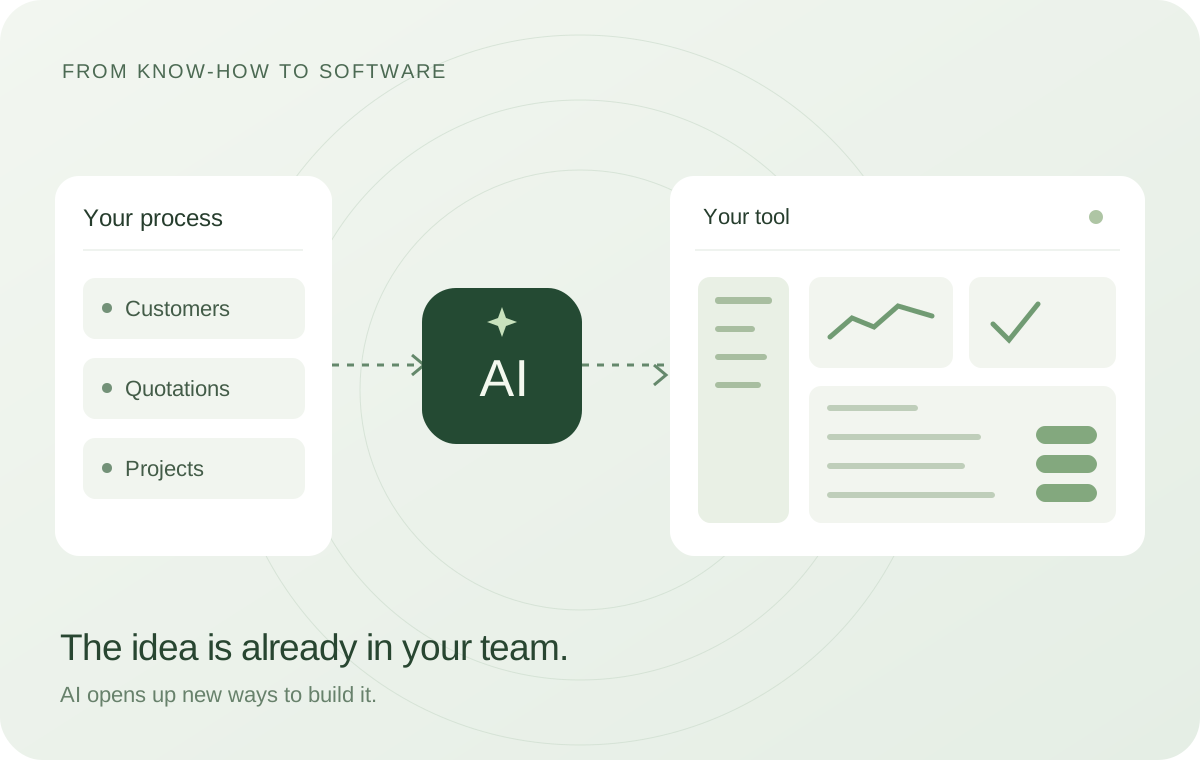
That knowledge is already inside the business. The difficult step is turning it into a tool.
With vibe coding, you can describe what you want to achieve, try an initial version and keep refining it. You see a screen, notice a missing piece of information, change a rule, add a check.
You think through the software as you build it.
Anyone who has spent weeks explaining a need that seemed perfectly clear knows how valuable this can be.
The advantage of building custom software with AI
An internal tool has an important advantage: it can be designed around a specific group of people and a familiar process.
A commercial CRM has to accommodate customers with different structures and needs. Yours can focus on the information and steps your team actually uses. The same applies to a configurator, project management or a materials planning tool.
The more specific the need, the more worthwhile it is to compare in-house development with buying and customising a product.
Of course, an MRP system that production depends on needs to be reliable even if only a few people use it. You can start with a clearly defined function, test it alongside the existing system and expand it when the results justify doing so.
One decision / Five criteria
Buy or build?
Start with how your business works.
Select an option to highlight it in the comparison.
| What to consider | Buy existing software | Build it with AI |
|---|---|---|
| The process | An existing product already fits the way you work. | Your process has specific needs that available products handle poorly. |
| Customisation | A few configuration changes are enough to get started. | Adapting the product requires extensive modifications, compromises or extra tools. |
| Integrations | The software already provides reliable connections to the systems you use. | You can start with a few specific connections, developed and tested for your needs. |
| The team | You want a supplier to handle development and maintenance. | You have people who know the process and can dedicate time to building, testing and developing the tool, with the support they need. |
| The total cost | Licences, implementation and customisation costs are proportionate to the value delivered. | Development, testing and maintenance are more cost-effective than buying and adapting the alternatives. |
You can start with a single function. A tool built by your team can sit alongside your existing management system, solve a specific problem and grow when it proves useful.
For people who know the process and learn to use AI tools well, the benefits can be very practical:
- Some of the time spent explaining becomes time spent building. Requirements still matter, but you can clarify them by working with AI on a functioning version.
- Feedback becomes immediate. You try the result, see what is missing and request a change while the problem is still fresh in your mind.
- You can work on several fronts. While the agent performs a defined task, you prepare data, think through the next step or get on with other work.
- You can start small and give yourself room to change your mind. Build the essential function, let people use it and add complexity where it is needed. Changing direction early can cost much less.
- The team gains reusable skills. What people learn on the first tool helps them build the second, improve related processes and tackle other tasks.
- You can bring development and publishing closer together. For some web applications, platforms such as ChatGPT Sites let you create, host and update a project in the same environment. Claude Artifacts let you create and share interactive tools within the platform’s capabilities and limits.
The initial outlay can also be modest. To give an indication, the Claude Max plan currently starts at 100 dollars per month, excluding taxes and subject to usage limits.
That is the cost of the AI tool. Of course, a project also involves people’s time, testing and, where needed, hosting, databases, integrations and maintenance.
But the opportunity to experiment with such a modest initial commitment remains considerable: you can find out whether an idea works before turning it into a major investment.
Control over software is also about business continuity
There is another question that deserves more attention: how much does your operation depend on a single supplier?
Imagine a small or medium-sized business that has spent years shaping the way it works around a heavily customised management system. If the people maintaining it stop supporting it, close down or change their terms, the difficulty directly affects the running of the business.
Developing internally can give you more control over changes, data and the evolution of the tool. For that control to be real, the business must be able to access the code, export its data and entrust maintenance to people other than whoever started the project.
An AI platform is a supplier too. Autonomy needs to be designed in from the start: documentation, company accounts, data backups and the ability to move the software where it needs to run.
That kind of control belongs in the decision alongside functionality and price.
Designing software from scratch lets you make it AI-ready
Building a new tool also creates an opportunity to rethink how people will use it.
You can design it to work with AI assistants from the outset: organised data, accessible functions, clear permissions. The environment you use every day can also become the place from which you look up information or initiate operations.
You can imagine requests such as:
- “show me the projects with the largest variances”
- “prepare a draft quotation with these conditions”
- “update this opportunity with the points from our meeting”
Software can be built around the work you want to delegate to AI and become the foundation for future agentic automation.
At ICAREX, we have developed automations with numerous companies, starting from their processes and systems. The SI Agents section shows practical applications of this work and the activities you can delegate to AI.
It is important to make room for people who want to try
All of this starts with AI adoption inside the business.
Among the more forward-looking companies, we are increasingly seeing a clear request: train internal teams and enable them to build their own tools. People already have the know-how; they want to learn a method for using it in a new way.
Time is often the obstacle. A manager overwhelmed by urgent tasks struggles to invest in something whose results are still uncertain. And an organisation used to established processes needs practical evidence before changing.
That is why we need to start with curious people: those who already experiment and ask how work could be improved. They can become the company’s first AI adopters, provided they have a clear assignment and dedicated time.
The approach can be very practical: choose a real problem, train a small group, support them as they build and let colleagues try the result. An AI Champion can emerge from this process: someone who shares what they have learned and helps other teams get started.
The first visible result makes the conversation much more concrete for everyone who has been waiting to see what happens.
Training creates new skills that stay in the business
A well-chosen adoption programme can deliver a quick return when it addresses frequent, costly tasks. The benefit needs to be verified in use: time saved, errors avoided, steps simplified.
There is also an effect that continues beyond the first project. AI skills combine with the know-how people already have. A sales manager will apply them to quotations and customers; an operations team will find opportunities in its workflows; a controller will use them in analysis.
Every useful tool the team builds increases its ability to tackle the next problem.
This is where we see the most interesting opportunity for businesses. ArtCraft encourages us to reconsider how accessible software development has become. The next step is to ask which capabilities we want to bring inside our own company.
What would your team build if you gave them the method, the time and the AI to do it?
At ICAREX, we can start there: upskilling and hands-on support on real cases, turning knowledge of the work into tools the team can use and continue to develop.