Yes or no.
Is this a refund request?
Probability of yes92%
A binary question. A probability from 0 to 1.
What is the right
next action?
A ticket to route. An invoice to check. An agent to guide. Discover models designed to choose between defined alternatives.

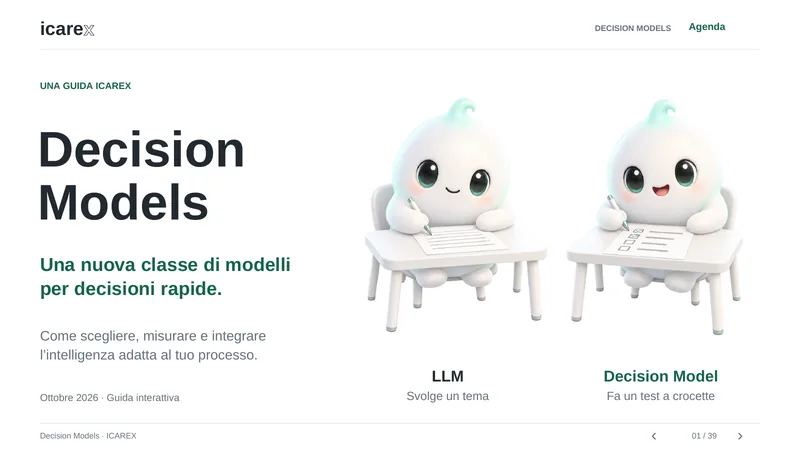
An LLM generates text, code and reasoning. A Decision Model evaluates defined alternatives and returns probabilities or scores. Software uses them to move work forward.
Like a multiple-choice test and an essay: the output differs. An LLM can classify too; we choose the approach that suits the task.
An allowed choice can still be wrong. The process checks rules and permissions before acting.
From language to software: structured answers, ready for the next step.
Is this a refund request?
A binary question. A probability from 0 to 1.
Which team should handle this ticket?
A distribution across alternatives: probabilities add up to 100%.
How urgent is action?
An ordered scale. The score is the probability-weighted average.
Simulated outputs. These names describe three primitives; interfaces vary by model.
How plausible the model considers an answer. p = 0.80 means an estimated probability of 80%.
How concentrated the output is on one answer. A clear choice has higher c; close alternatives, lower c.
c is not the probability of being right. Its formula depends on the model; Noul returns p directly.
The Decision Model evaluates the case. Orchestration selects a path using probabilities, confidence and the cost of an error.
HIGH CONFIDENCE · ACCEPTABLE RISK
REASONING NEEDED · SYSTEM 2
UNCERTAINTY OR HIGH IMPACT
The cost of an error matters: a €10 refund and a €100,000 payment need different checks.
Break a process into focused questions. Models interpret, code applies rules and people handle exceptions.
Conversation, history and policies
Intent · urgency · consent
Support rules and completed transactions
A customer reports a duplicate charge.
The workflow checks the transaction and amount limits before acting. The LLM prepares the message.
Probabilities across alternatives · total 100%.
Alert, asset and authorised activity
Expected activity? Sufficient evidence?
Asset criticality and authorised playbook
An unusual login affects a critical server.
The answers alone do not authorise containment: the playbook sets the required checks and approvals.
Three independent questions: each bar is p(yes). They do not add up to 100%.
Invoice, order, delivery and supplier
Consistency · anomalies · missing documents
Calculations, due dates and permissions in code
A €12,400 invoice is missing proof of delivery.
The system requests the missing document. Amounts, due dates and authorisations remain deterministic checks.
Probabilities across alternatives · total 100%.
Execution trace and feedback
Permissions respected? Goal achieved?
Compare task outcome and satisfaction
The customer says thanks. But did the agent finish the job?
The workflow checks the trace against the expected outcome and opens a review: satisfaction and success are different signals.
Three independent questions: each bar is p(yes). They do not add up to 100%.
Four workflows, four dedicated slides in the guide. Values shown are simulated; c follows the Choice example and is not comparable across models.
When every process contains thousands of microdecisions, latency and cost per decision become drivers of scale.
Software receives choices and scores, without having to interpret a free-form answer.
The workflow handles repetitive work. People focus on cases that require judgement.
Compare accuracy, time and cost per case. Then choose where to automate.
Median reported for Strands Decider v18 on NVIDIA RTX 3090. Varies with context length.
Provider benchmarkPrice published by Liquid AI on 5 October 2026. Each question is billed as a separate prompt.
Provider price and conditionsThese are two separate reference points, not a direct comparison. In your process we measure cost per correct decision, latency and quality: the benefit depends on the task.
Which model suits your workflow?
Explore metrics and comparisons in the guideA selection of available models. Access, inputs and performance guide the choice.
 TypeSafe AI
Three primitives for structured decisions.
 Liquid AI
Decisions on text and visual content.
 Cloudflare
Variants to balance quality and speed.
 Strands Agents
A compact model that can run locally.
Logos belong to the respective providers. The guide covers architectures and criteria for evaluating models on your use case.
From primitives to real processes. Understand where Decision Models can make a difference.
Enter your details to access the PDF.
The guide is in Italian.
Start with your process. Together, we assess models, data, risks and expected results.